Why Do Koreans Say “Fighting”?


Watch enough Korean dramas and you’ll see it: the main character clenches a fist and shouts, “Fighting!” Idols shout it to their fans. At the end of a meeting, a team leader tells everyone, “Let’s all do fighting.” And every November, students walking into the Suneung, Korea’s college entrance exam, hear younger students at the gate calling out, “Suneung fighting!”
To English speakers, it sounds strange. Fighting usually means, well, fighting. Plenty of foreigners wonder why a word for combat ends up in a word of encouragement.
A word for combat that became a cheer
In Korean, fighting squeezes “Hang in there,” “You can do it,” and “Do well” into a single word. You say it to a friend before an exam, to your child on the way to a job interview, even at the end of a text to a delivery driver. There’s no fight in it at all.
It’s flexible, too. You can shout it alone, or stack hands with a group and shout it together. When Koreans raise a fist in a group photo, that’s usually “fighting.” It works as a verb, as in fighting-haseyo (“Do fighting”), and as a noun for energy, as in “You’re full of fighting today.”
Most Koreans actually pronounce it hwaiting. Korean has no f sound, so it naturally slides toward an h. When people want to put extra force behind it, they may punch it out as paiting! The official Korean spelling is paiting (파이팅), but what you’ll hear far more often is hwaiting. That’s probably why the Oxford English Dictionary lists the Korean word hwaiting as one of its roots. Either way, it doesn’t sound much like the English word fighting.
Where did it come from?
The word comes from the English phrase fighting spirit. Shouted over and over as a rallying cry, it got trimmed down to just one short word: fighting.
When I was a child, nobody used this word. As far as I remember, it spread later.
At first it was something athletes shouted to themselves. Before a game, teammates would rally each other with it: let’s take them on with everything we’ve got, let’s give it our all. Even today, the Standard Korean Language Dictionary from the National Institute of Korean Language defines it first as “a shout among players in a sports game, meaning ‘let’s fight well,'” and only second as a shout from supporters to the players.
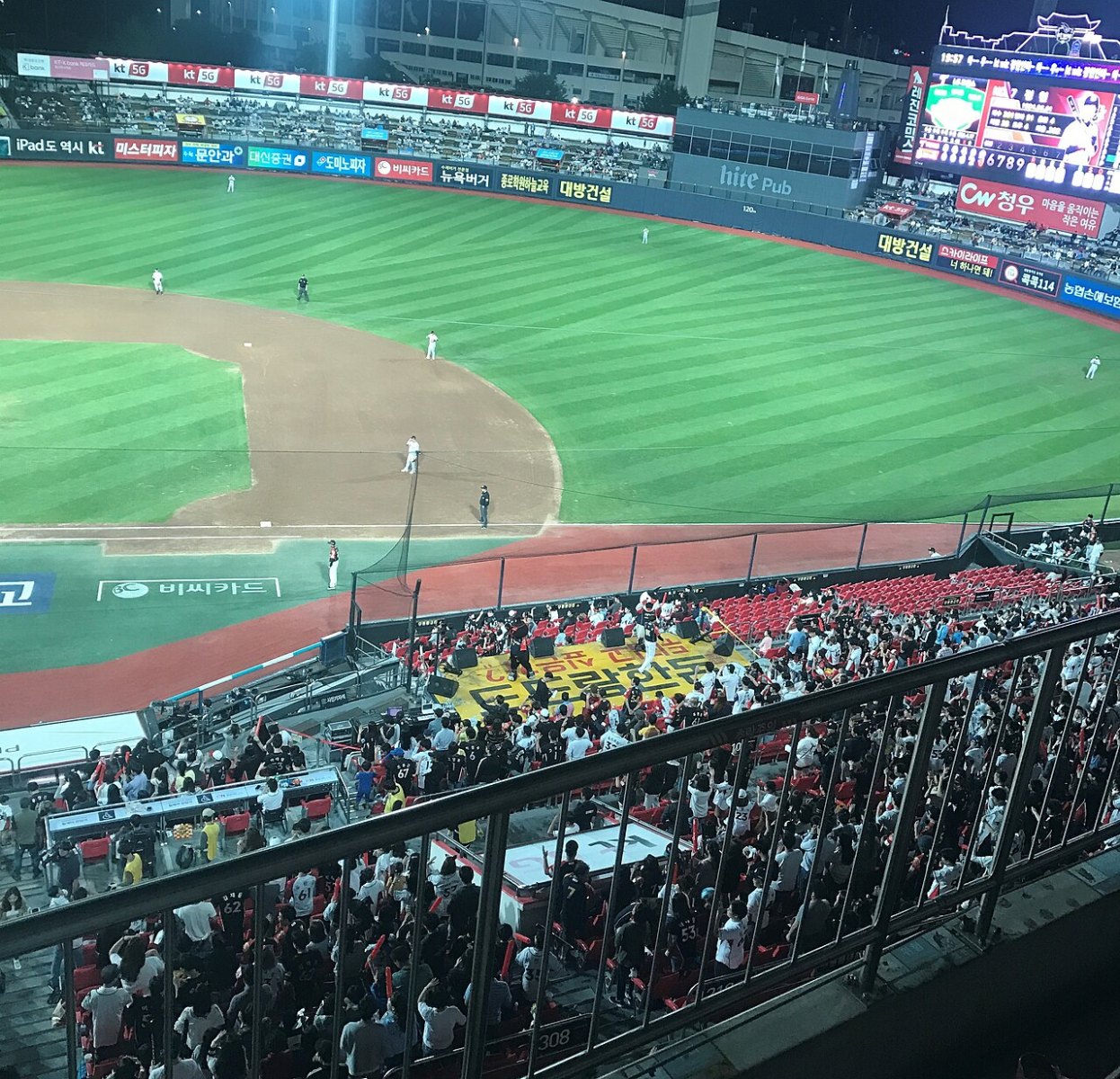
Ordinary people soon picked up what the players were saying. In neighborhood soccer games and company sports days, teammates would huddle up and shout “Fighting!” Then fans began using it from the stands to cheer on the players. Today it has gone well beyond sports. Whenever someone needs to find their strength, Koreans say fighting.
The National Institute of Korean Language once tried to replace it with native Korean words. It recommended himnaeja (“let’s find our strength”), and in August 2004, through a public word-refining campaign, it picked aja as the official alternative. But people didn’t choose between them. They simply started saying both: “Aja aja fighting!”
“Fighting” in the Oxford English Dictionary
In September 2021, the Oxford English Dictionary added 26 words of Korean origin in one update, including hallyu, mukbang, aegyo, and daebak. In that same Korean update, fighting joined the dictionary as an interjection.
The OED defines it as “especially in Korea and Korean contexts: expressing encouragement, incitement, or support.” For its origin, the dictionary lists both the English verb fight and the Korean word hwaiting. An English word went to Korea, picked up a new meaning, and came back to English.
The earliest English example the OED found dates from 2002. As it happens, that was the year Korea co-hosted the World Cup. In my memory, too, that is when fighting became everyone’s word. The Red Devils, the national team’s supporters, held up huge “Fighting” banners in front of the cameras, and crowds in red filled the streets and shouted it together. From then on, people used it as if it were standard Korean.
The two dictionaries also define it differently. Korea’s standard dictionary describes it as a sports chant, while the British dictionary describes a broad word of encouragement, like “Go on!” or “Go for it!” The difference comes down to timing. The Korean definition reflects the word as it first crept into use on the sports field, and back then, that was exactly what it meant. By the time it entered the Oxford dictionary in 2021, its meaning had grown far wider.
What I think, as a Korean
English has plenty of ways to cheer someone on: good luck, you got this, go for it, break a leg. But each one fits a different moment. What you shout in a stadium isn’t what you say to a friend before an exam, and neither is what you’d say quietly at the bedside of someone who is ill. I can’t think of a single English word for quietly rooting for someone.
In Korean, hwaiting covers all of it. Shout it at full volume in a stadium and it becomes a roar. Say it softly in a hallway and it’s a quick word of encouragement. Raise a fist without a sound, or add it at the end of a text, and it means the same thing.
When someone is battling an illness, Koreans don’t make long speeches. “I know you’re fighting this illness. I hope you beat it. I’m rooting for you, and I’ll be right here with you.” All of that gets folded into one word: hwaiting.
The volume changes, but the support stays the same size. From cheering out loud to standing by someone without a word, Koreans pack all of it into those three syllables. A word that once meant combat came to Korea and became one of our gentlest words of support.
If you want to say it yourself
- If a Korean friend has an exam, an interview, or a presentation coming up, a simple “Hwaiting!” is enough. A small fist pump makes it even better.
- Put a name or a task in front of it: “Minsu hwaiting!” “Suneung hwaiting!”
- To someone older, say hwaiting-haseyo.
- Outside Korea, saying “Fighting!” in English to someone who doesn’t know Korean may sound like you’re picking a fight. “Good luck!” is the safer choice.