Why Do Koreans Ask Your Age the Moment They Meet You?

One of the first questions a visitor to Korea hears is “How old are you?” A Korean will ask your name, maybe where you’re from, and then, almost right away, your age.
In much of the West, asking a stranger’s age is considered rude, so the surprise is understandable. Online forums for foreigners living in Korea are full of the same question: why does someone I just met care so much about how old I am?
For Koreans, though, this question has little to do with rudeness. If anything, it’s asked so that we won’t be rude.
Age isn’t just information. It’s grammar.
Koreans ask your age because we need to know how to talk to you. In Korean, the ending of a sentence changes depending on whether the other person is above or below you.
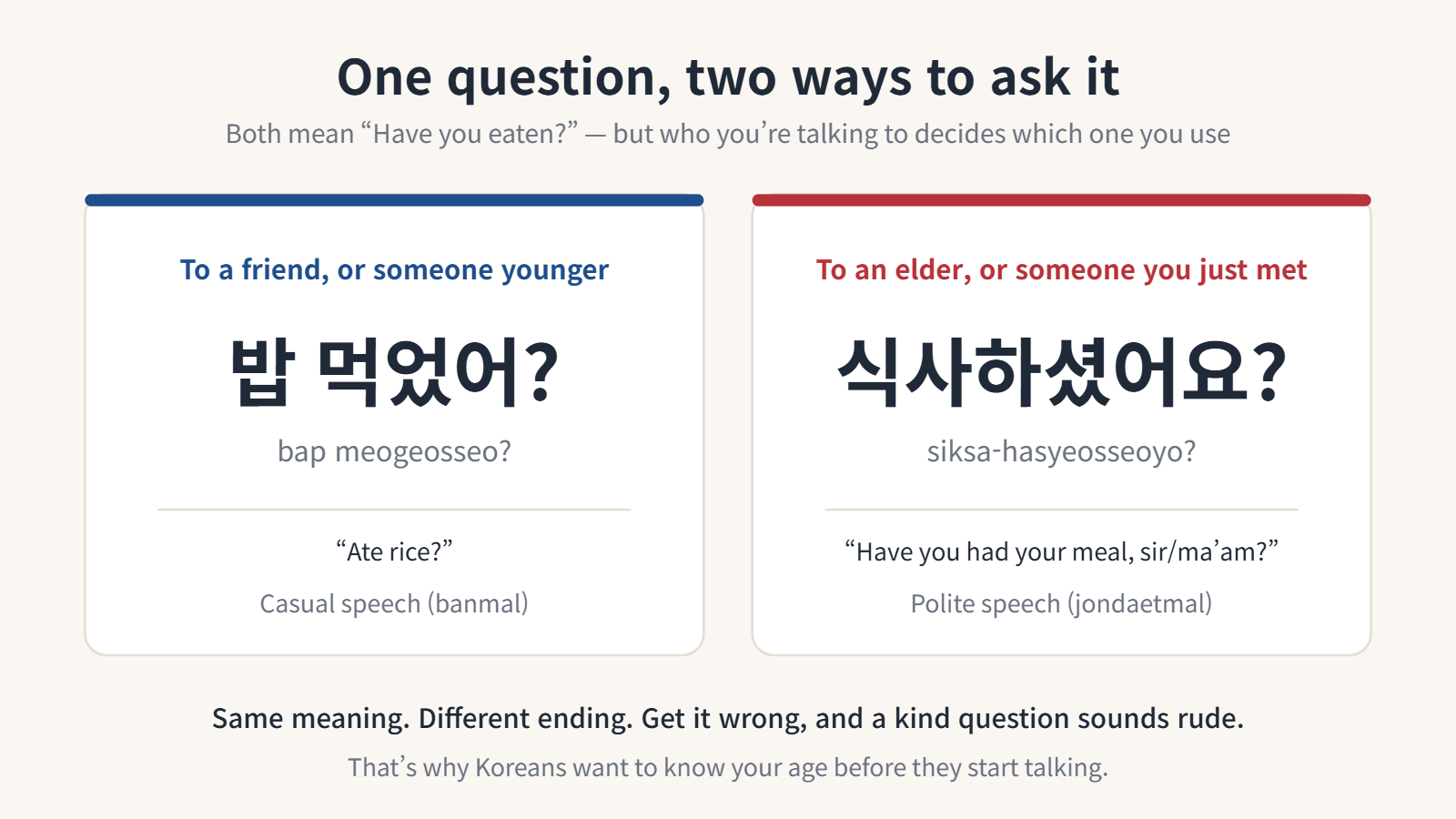
“Bap meogeosseo?” and “Siksa-hasyeosseoyo?” ask the same thing: “Have you eaten?” But say the first one to your grandfather and it sounds disrespectful. Say the second one to your best friend and it sounds oddly cold.
The same goes for what we call each other. Instead of names, Koreans often use relationship words: hyeong or oppa (older brother), nuna or eonni (older sister), seonbae (senior). The simplest and most objective way to decide who is who is age.
That’s why many Koreans don’t even ask “How old are you?” They ask “What year were you born?” Birthdays don’t matter much. Born in the same year? You’re friends. Born even one year earlier? You’re the older one.
So asking your age isn’t a way of judging you. It’s a way of checking how to speak without giving offense. The irony is that a question meant to be polite ends up sounding impolite to foreign ears.
The roots: a kingdom that taught the order of age
This grammar grew out of Confucianism’s Five Relationships. One of the five, described by Mencius, is jangyu-yuseo (長幼有序): between elder and younger, there is an order.
The Joseon Dynasty (1392–1897) didn’t leave this to chance. It turned the idea into books and taught it to ordinary people. Starting with the Samgang Haengsildo under King Sejong, the court later published the Oryun Haengsildo in 1797, by order of King Jeongjo.
The Oryun Haengsildo combined two earlier works into one. It collected 120 stories of devoted children, loyal subjects, caring siblings, and faithful friends, told with pictures and in Hangeul, the Korean alphabet. The illustrations are attributed to Kim Hong-do, one of Joseon’s great painters. It was, in a sense, a national textbook that even people who couldn’t read could follow.
Around the same time, King Jeongjo also had the Hyangnye Happyeon compiled. It laid out village rituals such as hyangeumjurye, a drinking ceremony where villagers practiced etiquette and order, along with hyangyak, the codes that governed village life. The king issued a royal message urging his people to honor their elders and keep these customs.
King Jeongjo also practiced what he taught. In 1795, during his royal visit to Hwaseong (today’s Suwon), he held a banquet for 384 elders at the Nangnamheon pavilion, from retired officials to local villagers. Each guest was served food and wine, and given a cane wrapped with a bolt of silk. Court painters recorded the day:
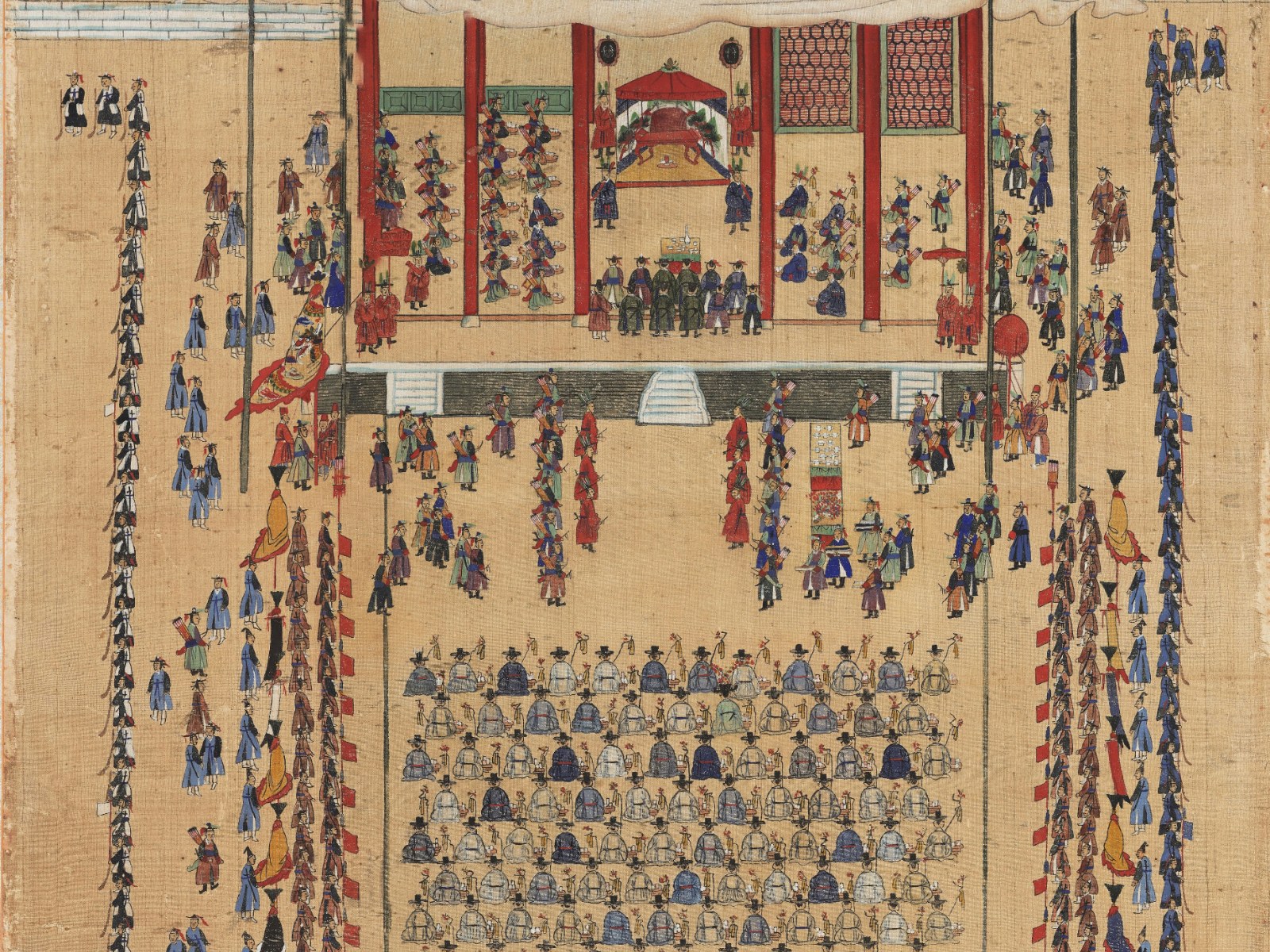
In other words, the order of age wasn’t just family manners. It was the social order, taught by the village and by the state.
Today: age is getting lighter
The clearest sign of change came on June 28, 2023, when Korea’s so-called “international age” law took effect. For generations, Koreans counted age the traditional way: you’re one year old at birth, and everyone gets a year older together on January 1.
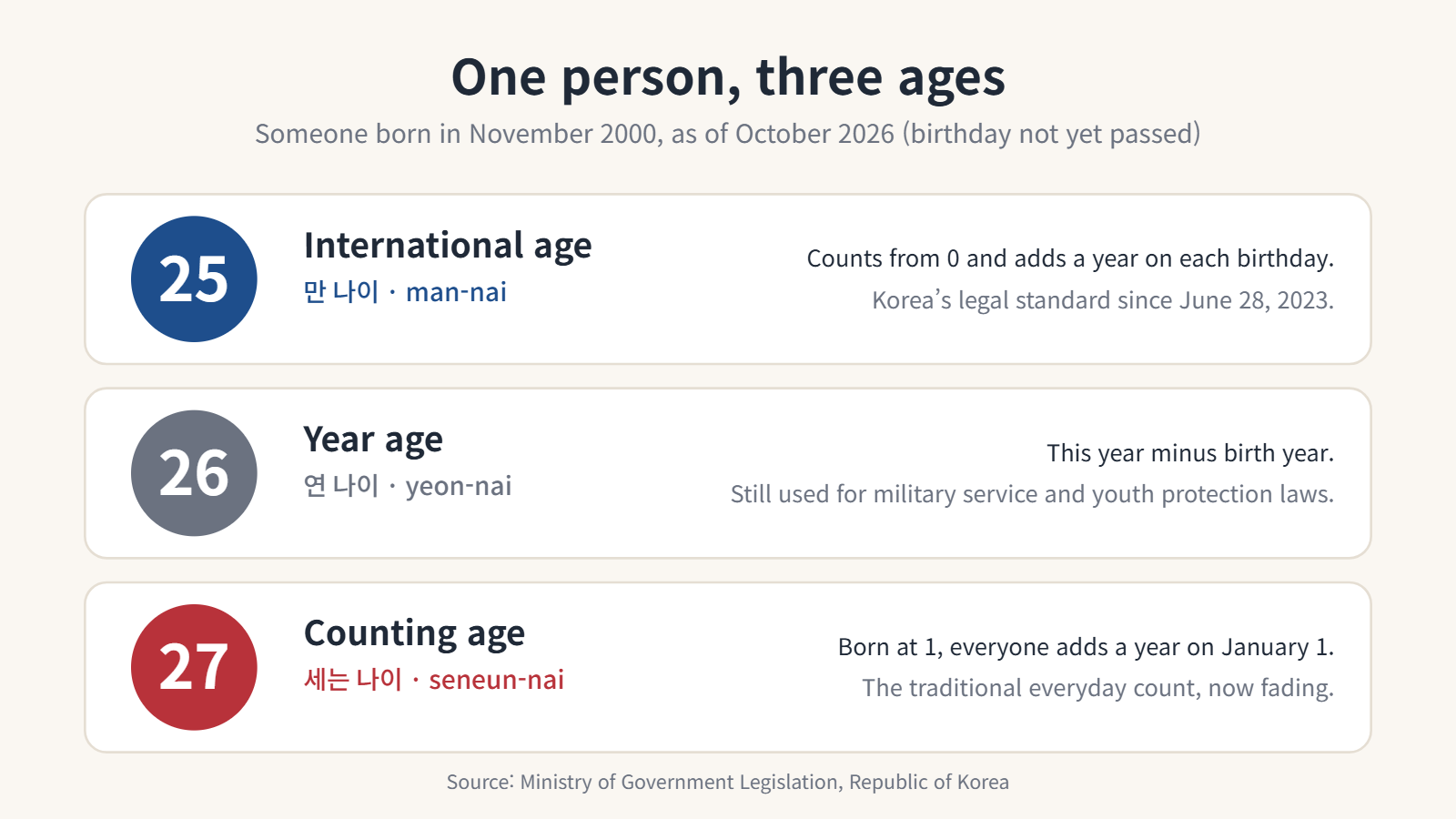
Legally, Korea had used international age since 1962, but everyday life ran on a different clock. With amendments to the Civil Act and the Framework Act on Public Administration, ages in laws and official documents are now counted the international way. A few laws, such as those on military service and youth protection, still use “year age.”
What I find interesting is the government’s hope. The Ministry of Government Legislation said it expected that, as international age became familiar, the habit of strictly ranking people by one or two years would fade too. A law about counting age was meant to nudge the culture as well.
The language is shifting, too. The National Institute of Korean Language published its Standard Language Etiquette guide in 2011. In 2020, it released a new guide titled What Shall We Call Each Other?, moving away from fixed rules toward forms of address chosen with mutual consideration. More and more companies now drop job titles and simply add -nim, a respectful suffix, to everyone’s name.
What I hope for, as a Korean
I have lived inside this culture for more than sixty years. Honestly, there was a time when age was used like a form of power. I think it’s a good thing that this is fading.
But I don’t think we should throw away the whole culture of age. What I hope for is a generation like this:
Older people understand that age alone is not authority. Younger people don’t dismiss the experience that comes with age.
If the “order” in jangyu-yuseo can survive not as a ranking from top to bottom, but as an order of courtesy toward each other, then it’s a tradition worth keeping.
If a Korean asks your age
- Just answer. It’s not a rude question here.
- Use polite speech until the other person says, “You can speak casually with me.”
- If a Korean starts calling you hyeong or eonni, it isn’t about rank. It means you’ve become close.