
Why Do Koreans Turn Their Heads When They Drink?

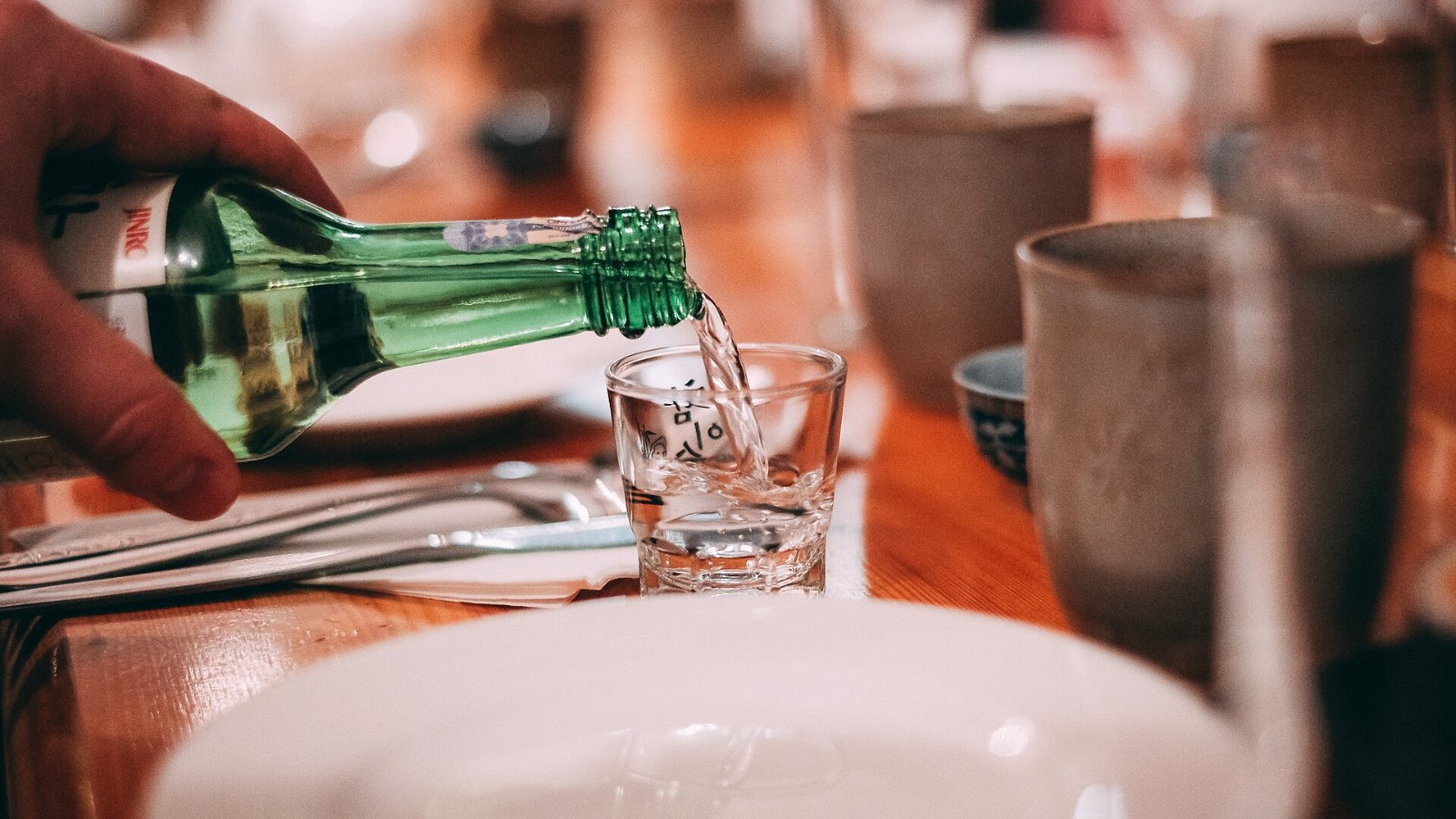
If you’ve ever shared a drink with Koreans, you’ve probably seen this. When the youngest person at the table lifts a glass, they turn their head to the side and cover the glass with one hand. They hold out both hands to receive a pour. And when someone’s glass runs empty, somebody fills it before anyone asks.
To a foreigner, it can look like a complicated set of rules. But all of these gestures point in one direction: staying composed, even after a few drinks.
The drinking table starts at the dinner table
Koreans talk about bapsangmeori yejeol, roughly “manners at the rice table.” You pick up your spoon only after the eldest has picked up theirs. You chew quietly. You don’t dig through the side dishes. And even when you’ve finished, you don’t put your spoon down or leave the table before the elders do.
The Encyclopedia of Korean Folk Culture, published by the National Folk Museum of Korea, notes that these rules already appear in Joseon-era books such as Naehun, a 15th-century guide to conduct, and Sasojeol by the scholar Yi Deok-mu. Naehun puts it simply: don’t make noise when you eat.
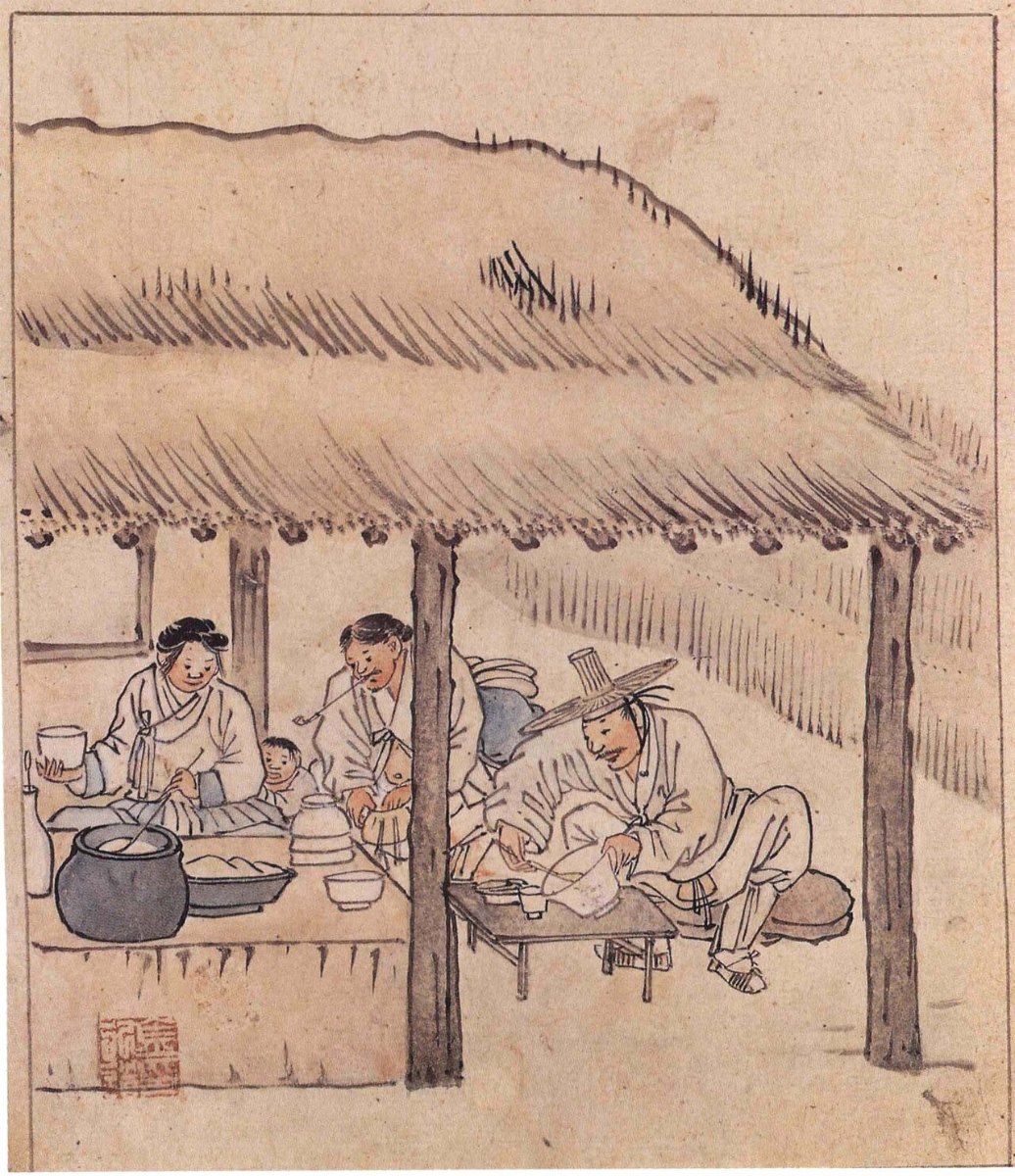
The Book of Rites, one of the Confucian classics, says that rites begin with food and drink. Koreans first learned manners at the dinner table, and the drinking table was simply an extension of it.
In the Analects, Confucius’s disciples recorded how their teacher lived, down to how he ate. At the end of that passage comes one line about drinking: yuju muryang, bulgeumnan (唯酒無量 不及亂). He set himself no fixed limit for wine, yet he never drank to the point of disorder. Drink a lot or drink a little, but don’t come apart. That is the line Korean drinking manners are meant to hold.
Every move has a procedure
Korean drinking etiquette is old. The Encyclopedia of Korean Culture, published by the Academy of Korean Studies, lists customs handed down since the Joseon Dynasty:
- Receive a glass from an elder with both hands.
- In front of an elder, turn your upper body away and shield the glass as you drink. This is where the “head turn” comes from.
- When pouring, hold the bottle in your right hand and support your right arm with your left. The habit dates back to wide sleeves that could brush the food.
- Don’t keep two glasses in front of you. When someone hands you a glass, empty it and hand it back.
- If you can’t drink, touching your lips to the glass and setting it down is perfectly polite.
The late-Joseon scholar Yi Deok-mu wrote in Sasojeol that even if the drink you’re given is strong, you shouldn’t show displeasure, and you shouldn’t gulp it down carelessly.
And it isn’t only about gestures. All evening, you keep an eye on the table and refill whoever’s glass is empty. There’s a proper way to offer a drink, depending on who the other person is, and a proper way to receive one.
Why go this far: the village drinking rite
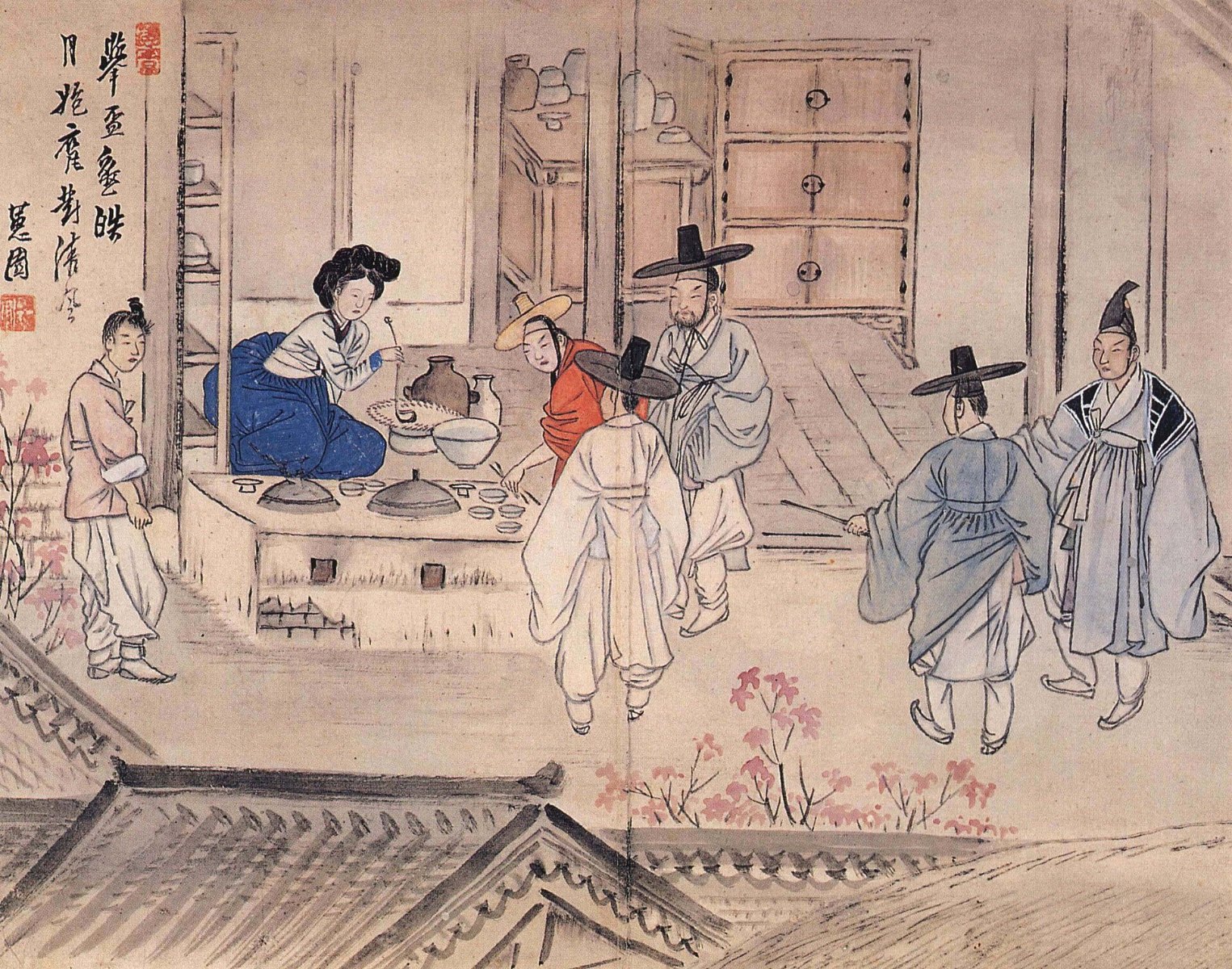
Joseon had a ceremony called hyangeumjurye, the village drinking rite. Villagers gathered and drank according to a set procedure. Seats were arranged by age, and the first cup went to the eldest. The drinking table was a place to learn manners. (I touched on this rite in Why Do Koreans Ask Your Age the Moment They Meet You?)
Jeong Do-jeon, the scholar-official who helped design the Joseon state, described its purpose in his collected works, Sambongjip: drink joyfully but never recklessly, and keep the formality without drifting apart from your elders.
Once a procedure is set and drilled into the body, your behavior holds even after the alcohol kicks in. Korean drinking etiquette was built to keep you from losing yourself. The Encyclopedia of Korean Folk Culture passes on another old saying: the first glass you pour for someone is ye (禮), courtesy, and the second is jeong (情), affection. You start with courtesy and move toward warmth, but your posture shouldn’t crumble along the way.
“Learn to drink from your elders”
Koreans say you should learn to drink from your elders. What you learn isn’t just how to hold a glass. It’s knowing your limit, not picking up bad drinking habits, and not embarrassing yourself, wherever you are.
There’s a blunt Korean expression, sul meokgo gae-ga doenda: “to drink and turn into a dog.” It describes someone who falls apart after a few drinks. What the elders hoped to teach was the opposite. It’s the bulgeumnan of the Analects, the composure of a seonbi, the Joseon scholar-gentleman who never came undone, however much he drank.
That teacher was often your father. The father who taught you when to pick up your spoon at dinner became your teacher at the drinking table too. In Korea, a father was traditionally someone you approached with care, not a buddy. When you receive your first glass from someone like that, you mind your manners from the very start. A 2015 column in the Maeil Shinmun, a Daegu daily, urged parents to sit down with their children, talk slowly, and let them learn drinking manners with their bodies.
A warning for today: form without restraint backfires
Still, there’s a catch in following that advice today. In late 2017, the Korea Health Promotion Institute, under the Ministry of Health and Welfare, surveyed 1,045 middle and high school students in five major cities. Teens who had been offered alcohol by their parents were 2.3 times more likely to have drunk in the past month than those who hadn’t.
The Hankook Ilbo, which reported the findings, pointed out that teaching only drinking etiquette, without stressing moderation, can end up encouraging children to drink.
Etiquette is a vessel for restraint. If you learn only how to receive a glass and never learn restraint, learning to drink from your elders loses its point. And that lesson should wait until adulthood.
What I think, as a Korean
Korean drinking etiquette turns every move at the table into a procedure and engraves it into the body. You watch the people around you, fill the empty glasses, and know how to offer and how to receive. With those habits built in, your posture holds even as the alcohol rises.
It all starts at the dinner table. The child who never picked up a spoon before the elders grows up to turn his head and empty his glass in front of them. A seonbi who stays composed with a drink in hand: that is who Koreans hoped to become when they learned to drink from their elders.
If you drink with Koreans
- When an elder pours for you, hold your glass with both hands, and turn your head slightly when you drink.
- Keep an eye on other people’s glasses and refill them. It leaves a good impression.
- If you don’t want to drink, or can’t, just touch the glass to your lips and set it down. Saying no isn’t rude.
- Above all, not getting drunk is the best manners there is.