
Rip-offs in Korea: Why Tourist Complaints Hit a Record, and How to Avoid Them

More foreigners are visiting Korea than ever before. In 2025, 18.94 million came, breaking the pre-pandemic record of 17.5 million set in 2019.
Complaints are breaking records, too. From January to July 2026 alone, the Korea Tourism Organization received 1,753 tourism complaints, already more than in all of 2025 (1,744). Foreign visitors filed 84% of them.
More guests can mean more complaints, of course. But over the same period, the average foreign visitor’s stay shrank from 7.8 days to 6.5. People are coming in greater numbers, but they’re staying for less time.
What’s going wrong
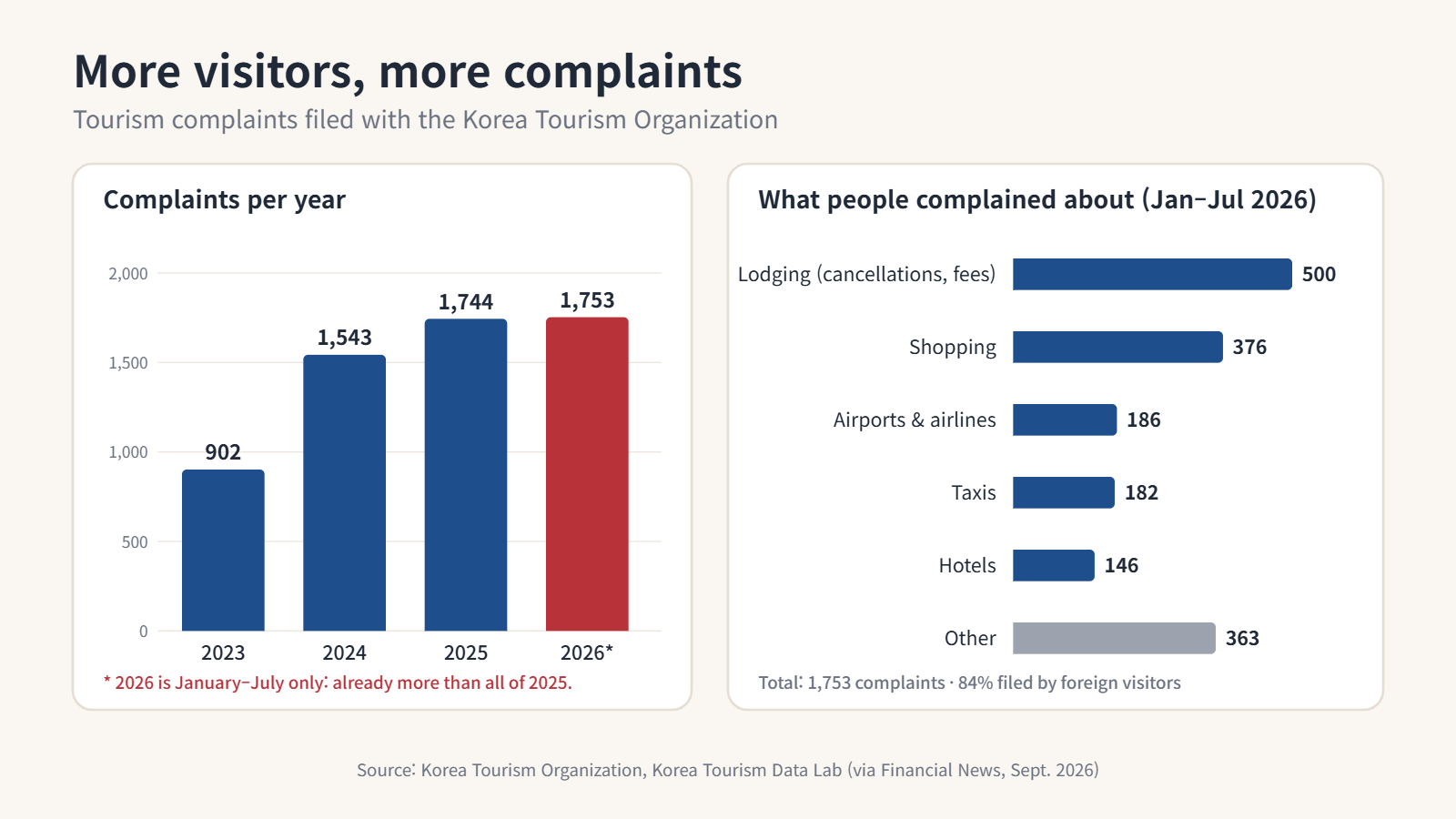
The biggest problem is lodging. Of the 1,753 complaints, 500 (about 29%) were about guesthouses and other ordinary accommodation: bookings canceled without warning, or cancellation fees far beyond what’s fair. When a big concert or festival drives up demand, some hosts cancel reservations they’ve already accepted and resell the rooms at a higher price.
Shopping came second (376 complaints), followed by airports and airlines (186) and taxis (182). With taxis, the complaints weren’t only about inflated fares but also about reckless driving.
By region, Seoul (665) and Busan (594) topped the list. In Busan, complaints jumped about 2.5 times from the year before, after BTS’s world tour concerts drew huge crowds in June. Where the crowds go, the rip-offs follow.
How Korea is responding: one strike and you’re suspended
The government isn’t sitting still. Since August 4, 2026, under a revised enforcement decree of the Tourism Promotion Act, a business caught overcharging faces penalties from the very first offense, instead of a warning.
- Lodging and restaurants: a 5-day business suspension for the first offense, 10 days for the second, 20 days for the third. Lodgings caught a fourth time are ordered to close.
- Taxis: a driver who overcharges loses their license for 30 days, then 60 days, and has it revoked on the third offense.
The government also plans to require lodgings to report their prices in advance, and to penalize cancellations made without a valid reason. In other words, the law is still catching up with the booking-cancellation problem.
Why this embarrasses me, as a Korean
Honestly, it’s embarrassing. Korea has a long tradition of treating guests from far away with care. Yet at a time when more guests are arriving than ever, some of them are being greeted with rip-offs and canceled bookings.
To be clear, most Koreans and most Korean businesses deal honestly. But for a traveler, a single rip-off can become their memory of the whole country. That’s why it can’t be brushed off as just a few bad apples.
If you’re treated unfairly here, please don’t just put up with it. Report it. A rising number of complaints is embarrassing, but it also means problems are coming to light, and that they have a chance of being fixed.
How to avoid getting ripped off
- Confirm your booking twice. During big concerts or festivals, contact your lodging again a few days before you arrive. Book through platforms with clear refund policies, and keep a screenshot of your confirmation.
- Use an app for taxis. Kakao Mobility’s k.ride app is made for foreign visitors: you can pay with an overseas card and see the estimated fare before you ride. If you hail a taxi on the street, check that the meter is running and ask for a receipt.
- No price tag? Ask first. At markets and street stalls without posted prices, confirm the price before you order.
- If something goes wrong, call 1330. The Korea Tourism Organization’s Korea Travel Hotline runs in eight languages, with English, Japanese, and Chinese available 24 hours a day. From a foreign phone, dial +82-2-1330, or use the free call button in the VisitKorea app. You can also chat via KakaoTalk or LINE. They can help you file a formal complaint, too.