
Korean Date Labels: Manufacturing Date vs Best Before vs Use By — A Practical Guide

📍Meta description
Decode Korean date labels into clear actions: Manufacturing date, Best before, Use by, “until” wording, and storage phrases.
Last updated: 2026-02-24
🧭ONE-LINE ANSWER
Use by = Don’t consume past this date.
Best before = Quality date; decide using storage + condition.
Manufacturing date = When it was made; use storage rules to judge freshness.
🧾CHEAT SHEET
Korean term | Common English | What it really means | What to do next
✅제조일 | Manufacturing date | Date the product was made | Use as the starting point; always check storage terms.
✅유통기한 | Best before | Quality date (not automatically “discard”) | If stored properly, judge by condition; be conservative for high-risk foods.
✅소비기한 | Use by | Consumption safety guideline | Do not consume past the date as a rule.
✅~까지 | until / by | Usually treated as “until that date” | If the product is sensitive or layout is unclear, choose the safer option.
✅개봉 후 | After opening | Rules start from the moment you open it | Follow “after opening” first; treat missing time limits conservatively.
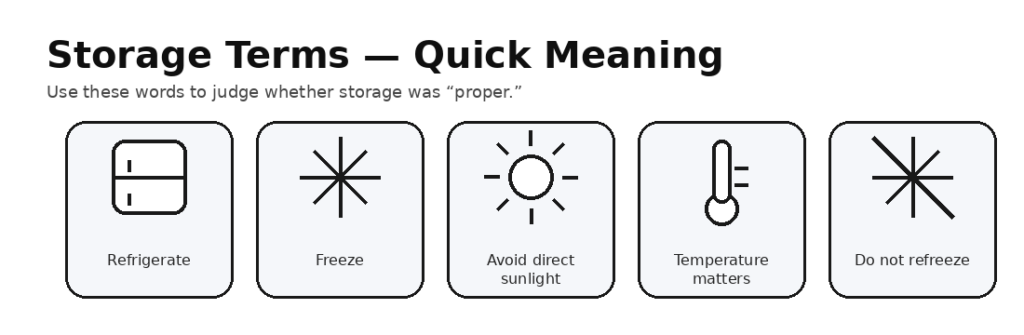
✅보관방법 | Storage instructions | Temperature/light guidance | Use these terms to decide what’s “properly stored.”
✅냉장보관 | Refrigerate | Keep chilled | Return to fridge quickly; avoid long room-temp exposure.
✅냉동보관 | Freeze | Keep frozen | Follow thawing notes; do not refreeze if instructed.
✅실온보관 | Room temperature | Store away from heat and sunlight | Keep in a shaded cabinet; avoid warm kitchens/windowsills/cars.
✅직사광선을 피하여 | Avoid direct sunlight | Light/heat degrades quality | Store in shade; keep away from heat sources.
✅서늘한 곳 | Cool place | Not warm, not humid | A cabinet away from stove/oven/sun is a “cool place.”
✅해동 후 재냉동 금지 | Do not refreeze after thawing | Refreezing increases risk/quality loss | Thaw only what you need; avoid refreezing thawed portions.
🗓️WHERE TO FIND THE DATE
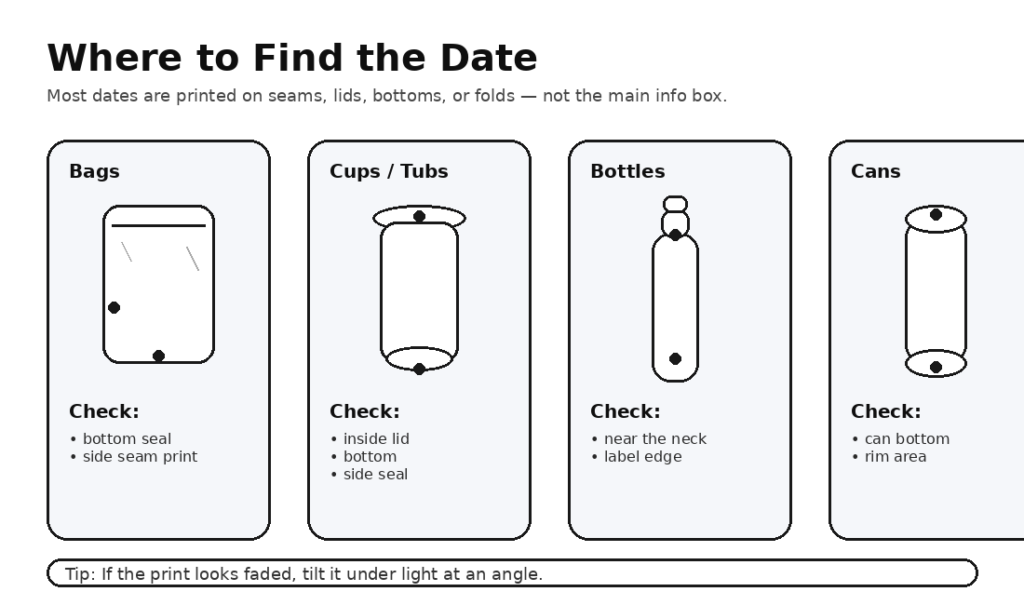
Dates are often printed on seams, folds, lids, or bottoms — not inside the main “info box.”
Bags (snacks/ramen): back bottom seal or side seam print
Cups/containers: inside lid, bottom, or side seal
Frozen foods: back bottom area or near folds/creases
Bottles/cans: label edge, bottle neck area, or can bottom
Sticker labels (market labels): near barcode or the storage-instructions panel
Tip: If the print looks faded, tilt it under light at an angle.
📌DECIDE IN 4 STEPS
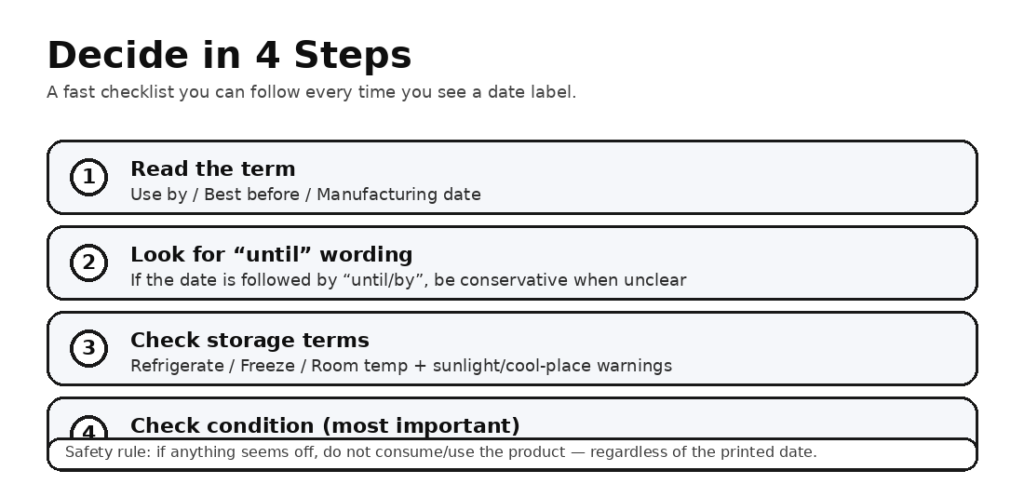
- Read the term next to the date: 제조일 / 유통기한 / 소비기한
- Look for “~까지” to understand “until” wording
- Check storage: 냉장보관 / 냉동보관 / 실온보관 + sunlight/cool-place warnings
- Check condition (most important): swelling, leaks, odd smell, color change, slime/texture change
If anything seems off, do not consume/use the product — regardless of the printed date.
🚫COMMON MISTAKES
Treating Best before (유통기한) as an automatic discard date
Ignoring After opening (개봉 후) rules because the printed date looks fine
Assuming Room temperature (실온) means “anywhere indoors,” including warm kitchens
Trusting the date while ignoring warning signs (swelling/leaks/odd smell)
Deciding from Manufacturing date (제조일) alone without checking storage terms
❓FAQ
Q1) If the label says “YYYY.MM.DD까지,” is that date included?
In everyday label usage, it’s commonly treated as “until that date.” When the product is high-risk or the layout is ambiguous, choose the safer option.
Q2) Can I consume something past “Best before”?
It’s a quality guideline, not a guarantee. Your decision should depend on storage and condition. For high-risk foods, be conservative.
Q3) What if I only see “Manufacturing date”?
Use it as the starting point, then follow storage instructions and product type guidance. If you’re unsure, choose the safer option.
Q4) The label says “After opening: refrigerate,” but no time limit. What then?
Treat missing time limits conservatively. Refrigerate promptly and avoid long room-temperature exposure.
Q5) I can’t find the date. Where should I check first?
Seams, bottoms, lids, and folds. Sticker labels near barcodes can also include dates.
📸DECODE REQUEST (COMMENTS)
Post a label photo or link in the comments. You’ll get a reply in this format:
Meaning (what the term implies)
Common translation traps
What to do next (clear actions)
✅Photo checklist
Include the full label panel (date + storage/warnings)
For food, include ingredients + allergen section if possible
Blur personal info if visible (address/phone/order number)
🧩Copy-paste template
Product type: (food / cosmetics / electronics / household / other)
What to decode: (date / storage / allergy / mark / sorting)
Visible terms (optional):
Photo/link:
— KoreaFeel